Showing posts with label Cipher Runes. Show all posts

Wednesday, March 14, 2012

Hahalruna and Persian Khatt-i-Shajari

 I recently wrote about Hahalruna and El-Mushajjar, showing how the Arabic tree writing was a perfect port of Norse hahalruna (cipher runes) into Arabic writing. While writing that article I became aware of a very similar Persian cipher called Khatt-i-Shajari (Tree writing). Just as the Germanic people devised many variations based on the concept behind hahalruna (iisruna, lagoruna, etc), so too did the Persians. The Persian adaptations include smoke signals, hand signs, and tapping that sounds oddly like Morse code. I have read that the Celts used similar methods to communicate their Oghams. I see no reason to believe the Old Norse did not also communicate their runic ciphers in just as many creative forms. Even if they did not, perhaps modern Rune Masters should.

Although Sir Richard Burton and others mention this Persian code, the best description I have found is in A Year Amongst the Persians:
impressions as to the life, character, and thought of the people of Persia, received during twelve month's residence in that country in the years 1887-8. (Edward Granville Browne, published 1893) :

While I am on the subject of these linguistic curiosities, I may as well mention a method of secret communication sometimes employed in Persia, the nature and applications of which were explained to me by my Erivani friend a few days before his departure for Mashhad. Such of my readers as have studied Arabic, Persian, Turkish, or Hindustani will know that besides the ordinary arrangement of the letters of the Arabic alphabet there is another arrangement called the "abjad" (from the four letters alif, ba, ,jim, dal which begin it) representing a much older order. The order of the letters in the abjad is expressed by the following series of meaningless words, consisting of groups of three or four letters each supplied with vowel-points to render them pronounceable :—abjad, hawaz, hoti, kalaman, sa'fas, karashat, thakhadh (sakhaz) dhadhagha (zazagha). In this order each has a numerical value ; alif= 1, ba = 2, jim = 3, dal = 4, and so on up to ya = 10 ; then come the other tens, kaf= 20, lam=30, and so on up to kaf= 100; then the other hundreds up to gheyn=l000. The manner in which, by means of this abjad, words and sentences may be made to express dates is familiar to all students of these languages, and I will therefore only give as a specimen, for the benefit of the general reader, the rather ingenious chronogram for the death of the poet Jami, premising that he was a native of the province of Khurasan ; that "smoke" or "smoke of the heart" is a poetical term for sighs; and that to "come up from" in the case of a number means to be subtracted from.

This, then, is the chronogram: "Dud az Khurasdn bar amad," "Smoke (sighs) arose from Khurasan," or "dud (dal = 4, vav=6, dal = 4 ; total 14) came up (i.e. was subtracted) from Khurasan" (kha= 600, ra= 200, alif= 1, sin =60, alif= 1, nun = 50; total 912). Taking 14 from 912 we get the date of Jami's death, a.h. 898 (= a.d. 1492).

The method of secret communication above alluded to consists in indicating first the word of the abjad in which the letter to be spelt out occurs, then its position in that word. In communicating by raps, a double rap knocks off each word of the abjad, while on reaching the word in which the desired letter occurs its position in that word is indicated by the requisite number of single raps. An instance will make this clearer. It is desired to ask, "Nam-i-tu chist ?" (" What is thy name ?") : the letters which spell out this message are—niun, alif, mim, ta, vav, jim (for chim), ya, sin, ta. Nun is in the fourth word of the abjad, and is the fourth letter in that word (kalaman). It is therefore indicated by three double raps (removing or knocking off the three first words, abjad, hawaz, hoti, and thus bringing us to the next word, kalaman), followed by four single raps (showing that it is the fourth letter in this word). The remaining letters are expressed in similar fashion, so that if we represent double raps by dashes and single raps by dots, the whole message will run as follows: — — — • • • • (nun); (alif) ; — — — • • • (mim); — — — — — • • • • (ta)  • • (vav); • • • (chim or jim); — — • • • (ya); — — — — (sin); — — — — — • • • • (ta).

Messages can be similarly communicated by a person smoking the kalyan or water-pipe to his accomplice or partner, without the knowledge of the uninitiated. In this case a long pull at the pipe is substituted for the double rap, and a short pull for the single rap. Pulling the moustache, or stroking the neck, face, or collar (right side for words, left side for letters), is also resorted to to convert the system from an auditory into a visual one. It is expressed in writing in a similar fashion, each letter being represented by an upright stroke, with ascending branches on the right for the words and on the left for the letters. This writing is called, from the appearance of the letters, khatt-i-sarvi ("cypress-writing") or khatt-i-shajari ("tree-writing"). In this character (written, in the usual way, from right to left) the sentence which we took above ("nam-i-tu chist ?") will stand as follows :—


From the description given by Mr. Browne I was going to make a nice table with Persian letters and their khatt-i-shajari equivalents. The only problem is I did not know what letters to use. Sir Richard Burton gives us a version of the cipher (HERE):
As with the cipher preceding it in Burton's article, this cipher only has 22 letters. Of this Burton writes "it contains only the ancient and universal Semitic letters, lacking the last six of Arabic". Sir Burton then tells us the cipher I just showed you above "is applied to Pehlevi or old Persian". When I did a google search for Pehlevi and Old Persian I got about twenty different scripts and not knowing much about Old Persian, I didn't want to make a guess at which one might be correct. 
From the information supplied by Mr. Browne I see that the Arabic letter jim is used in place of the Persian letter chim. The other variant letters probably also use the Arabic letter they resemble. So, using the information supplied by Mr. Browne, I have retrofitted the old Arabic cipher given by Ibn Wahshiyah simply by removing one limb from the right of every tree in the El-Mushajjar cipher, thus:

As you can see, the Persian version of the cipher is a slightly more economical variation of Arabic tree writing.
Anyway, it seems I have gone another night without sleeping. If you have feedback or more information on any of the codes and cyphers I have written about, please let me know.


Creative Commons License
Hahalruna and Persian Khatt-i-Shajari by Jason Bales is licensed under a Creative Commons Attribution-ShareAlike 3.0 Unported License.
Based on a work at greybookofrunes.blogspot.com.

Sunday, January 22, 2012

Hahalruna and El-Mushajjar

On January 18th I googled Cipher Runes at 3 a.m. When I clicked the first result, I found that Wikipedia was blacked out for Americans to raise awareness of SOPA and PIPA.

So I decided to see what a public domain search at google books would turn up. The first search result was interesting, but when I got to Sir Richard Burton's Ultima Thule: or, a summer in Iceland, I paused. Sir Burton connects the Runic cipher to an Arabic cipher called "El-Mushajjar".

Soon I find an article Sir Burton wrote about "The Ogham-Runes and El-Mushajjar". In this article Sir Burton traces everything with a stick, branch, or stave back to Iran. The article is two parts genius and one part crackpot.

While reading related materials in google books I saw that later writers state that the Arabs based their El-Mushajjar cipher on the Norse cipher after coming into contact with Varangians. This explanation is simple and rational, but none of the sources put all the pieces together with simple diagrams in a step-by-step fashion.

So, that's what you're about to see...

Rune Ciphers
The first to use this cipher were the Germanic tribes. The marks were used to refer to Runes. The Runes were separated into three groups of eight Runes. These groups were called Aettir meaning "eights". The sense of the word Aett is "group" or "family". The first group or family of Runes is called Freyr's Aett after the god Freyr. Frey'r's name starts with the first Rune of the Aett, Fehu (F). The other Aetts are called Hagal's Aett and Tyr's Aett and start with Hagalaz (H) and Tyr (T) respectively.

The oldest explanation of the system as it is applied to Runes that I can find is that of Saint Gallen in the second half of the 9th century. In the Alcuin manuscript we see several types of the same cipher.


The first two types of cipher Runes described by Saint Gallen are called "iisruna" and "lagoruna". These are the Runes Isa and Laguz. In Saint Gallen's manuscript, the short Runes represent the Aettir. One short Isa or Laguz represents the first Aett, Freyr's Aett. Two short Runes represent Hagal's Aett. Three short Runes represent Tyr's Aett. Directly after the short Runes are taller Runes. The number of taller Runes tells you the index of the Rune.

The third type of cipher Rune described by Saint Gallen is called "hahalruna" and is based on the same pattern as the others. We make a vertical line. To the left of this line we make one, two, or three marks based on which Aett the Rune is in. Then we make a number of marks to the right of the center line equal to the Rune's index. If you slant the lines upward you get the forms you see in my table above. No matter which way the lines point, they mark either the Aett or index. Sometimes you see the lines facing upward on one side of the stave and downward on the other side.


The fourth type of Runic cipher described by Saint Gallen is called "soofruna". It's the same as the others, but with dots.

In all four examples, Saint Gallen has written the name CORVI.
iiIIIiiII:iIIIIiiiIIIIIiiiIIIII:iIiiiIIIIIIIIiIIiIIIII:iiiIIIiIIIIIIIiiIIIIIIIiIiiiIIIIiiIIIIIIiiiIIIIIiiIIIIIII;iiIIIIIIIIiIiiIIIiiIIiiiI:iIIIIIIIiIiiiIIIIIiiiIIIIIiiiIIIiiII:iiIiIiiIIIIIIII:iIIIIIIIIiIIIIIiiIIIiiiIiiiIiiiIIIiiII:iIIIiiiIII:iiIIiIiiiIIIIiiiIII:iIIIIIIiiiIIIIIIIIiIIIIIiIIiiIII

 As times went on, the Runes underwent some changes and were reduced in number to sixteen. The following table shows how the old cipher was applied to the Younger Futhark.


I could not find a good free Younger Futhark font, so I just wrote it out quickly on graph paper. I attempted to copy the rune forms found in Johan Gustaf Liljegren's Run-Lara.

As you can see, tree runes were used by the Norsemen before they journeyed into Arab lands and were still used in the Viking age.

El-Mushajjar
It was the opinion of Sir Richard Burton that the tree runes were an Arab invention that was borrowed by Varangians and adapted to use with their own runes. Why it did not occur to him that the transmission was from northern runes to Arabic is uncertain.

The oldest Arabic manuscript I could find that contains the cipher called El-Mushajjar is that of Ibn Wahshiyya (9th century):
The Arabic reads:
The alphabet of Dioscorides the philosopher, commonly called the Tree alphabet. He wrote on trees, shrubs, and herbs, and of their secret, useful, and noxious qualities in this alphabet, used since in their books by different philosophers.

Sir Richard Burton suggests that it was an Arabic translation of a work by Dioscorides that was written in this cipher and then attributed to Dioscorides. Let it be written down that I officially agree with Sir Burton about this one issue.

In his article in "Transactions of the Royal Society of Literature of the United Kingdom", Sir Burton gives the following form of the cipher:
Here Sir Burton mentions El-Abjad, but does not give much in way of explanation as to what that means.

The Arabic alphabet was originally arranged in a different order than you see it today. The letters, like the letters of so many other alphabets were also used as numbers. The change to Arabic numerals (which the Arabs call Indian numerals ;) had already occurred by the time Ibn Wahshiyya recorded the cipher. This can be seen by looking at many of the other ciphers in Ibn Wahshiyya's work. This leads me to believe that the ciphers recorded in Abjad sequence were already in use by Arabs before the new letter sequence arose and those with the new sequence were developed closer to the time Ibn Wahshiyya recorded them.

Of this system Idries Shah (The Sufis, 1964) writes:
While the Arabic letters have equivalents up to one thousand, the Hebrew alphabet has equivalents only up to four hundred, inclusive. For mnemonic purposes this arrangement of letters is always memorized as follows, as a string of meaningless words, adding diacritical points to make pronunciation possible:
ABJAD HAWAZ HUTY KALMAN SAFAS QURSHAT THAKHDZ DHATZAGH.

In Persian, Urdu and other non-Semitic languages, the letters are given slightly different sounds in some cases, but this does not affect the use of the letters, whose numerical values remain constant.

Date names, dates of birth or death, words expressing the character or aspirations of a person, all are often evolved from the scheme. Ignorant repetition of the meaningless words has in some places endowed the barbarous Abjad "words" with spurious baraka, the belief in special inherent functions, but this belongs to the realm of repetitious magical procedures and is not important.

It is at this point I would like to point something out. The Abjad system is based on number. So was the Elder Futhark. When viewed as a base-8 tally system, Hahalruna not only have a one to one relationship with the position of the Runes of the Elder Futhark within the three Aetts, but also give the numeric values of the Runes. This is not true for the Younger Futhark or Abjad adaptations. It is still a fine cipher system no matter what alphabet it refers to.

Here is a little table I made up showing the way in which the cipher was applied to Arabic:
The first Abjad "word" has one branch to the right, and the letter's index is indicated by the number of branches to the left. This reflects the right-to-left reading direction of Arabic.

So, yeah, this is what I did when Wikipedia went down for a day. What would I do if the internet kill switch were used?

Creative Commons License
Hahalruna and El-Mushajjar by Jason Bales is licensed under a Creative Commons Attribution-ShareAlike 3.0 Unported License.
Based on a work at greybookofrunes.blogspot.com.


ADDENDA
5:08 A.M.
Tuesday, 3/13/2012
I was up all night reading the internet again and just came across this text at Princeton:
http://pudl.princeton.edu/objects/bg257f09h
it's a text titled "Treatise on ancient, alchemical and magical alphabets"
I managed to find El-Mushajjar written in the left margin on this page:
http://pudl.princeton.edu/viewer.php?obj=bg257f09h#page/79/mode/1up

As marginalia goes, it looks pretty clumsy. Notice the modern letter order written underneath the cipher and then crossed out. The Abjad order is written above.

Monday, 7/30/2012
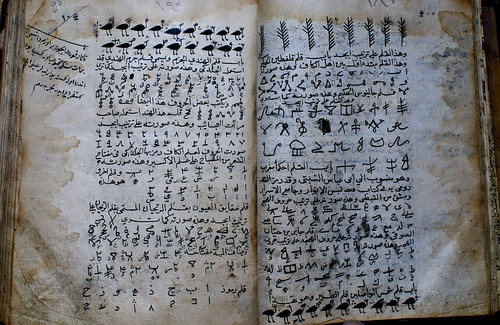
Take a look at this 18th century manuscript:
 In the upper right we see what looks like our El-Mushajjar cipher. But count the branches. If we translate the branches into numbers we get the following:

1:10 , 3:9 , 2:9 , 1:9 , 3:8 , 2:8 , 2(3):8 , 3:7

The second character, reading from the right is smudged and looks to me like the transcriber originally had 3:8 , but scraped away parchment to make it 2:8. As you can tell by comparing the tree runes in this manuscript with those in my table above, there's something different. Whereas there are only eight abjad words, the final tree rune implies at least ten.

The solution to this problem is simple. The 18th century version of this cipher makes its divisions based on the hijā’ī order of modern Arabic.


More on coded Runes:
http://www.arild-hauge.com/esecreter.htm